When the Brain Stops Playing: Why Cognitive Playfulness Matters More Than Ever
I've been watching something troubling unfold over the past decade. Adults – especially professionals and advanced language learners – are losing something essential: the ability to play with ideas.
This isn't about entertainment or leisure. I'm talking about cognitive playfulness, the capacity to manipulate concepts without immediate purpose, to explore mental territory just to see what's there, to hold contradictions comfortably while your brain figures out what to do with them. It's the difference between a mind that can only execute predetermined operations and one that can improvise, adapt, and genuinely create.
The decline is measurable. When I work with C1 and C2 English learners, many can discuss complex topics fluently but freeze when asked to make unexpected conceptual leaps. They've mastered the mechanics of language but lost access to its generative potential. Their thinking has become instrumentalized – language exists only to complete tasks, pass exams, write reports. The playful dimension, where language becomes a medium for exploration rather than just transmission, has atrophied.
This matters profoundly in the age of AI. Large language models excel at pattern recognition and statistical interpolation, but they cannot play. They remix training data with impressive sophistication, yet they lack the human capacity for genuine conceptual exploration – the ability to wonder "what if?" without predetermined outcomes, to find meaningful connections between radically distant ideas, to tolerate the productive discomfort of not knowing where a thought will lead.
The neuroscience here is clear. When we engage in cognitive play, we activate networks that would otherwise remain dormant. The brain's default mode network, responsible for imagination and self-referential thought, needs regular exercise just like any other system. Without it, we develop what I call "cognitive rigidity" – the inability to shift perspectives, adapt strategies, or generate novel responses to unfamiliar situations.
I see this rigidity manifesting in specific ways. Learners settle into "lexical fossilization," using the same safe vocabulary and grammatical structures repeatedly. They develop "premature cognitive closure," accepting the first adequate solution rather than exploring alternatives. They experience "conceptual monoculture," relying on a narrow set of mental tools because they've stopped encountering diverse frameworks that would expand their thinking.
The educational system often reinforces this. We've optimized for efficiency and measurability, which inevitably favors closed-ended tasks with predetermined answers. Open-ended exploration, the kind that requires genuine cognitive play, is harder to assess and slower to show results. So we've gradually eliminated it from curricula, particularly at advanced levels where learners are presumed to have "moved beyond" such activities.
But cognitive playfulness isn't developmental – it's not something you outgrow. It's a capacity that must be actively maintained throughout adulthood. Robert Kegan's research on adult development shows that psychological growth requires three conditions: stretch that challenges existing meaning-making, support that prevents defensiveness, and reflective space that allows new insights to settle. When any of these is missing, development halts even though the capacity for growth remains.
Most adults exist in what John Cleese calls "closed mode" – a defensive, judgmental mental state optimized for executing known procedures but hostile to exploration. We spend entire careers there, never shifting into the "open mode" necessary for creativity: tolerant of ambiguity, expansive, playful, receptive to unexpected connections.
The consequences extend beyond individual creativity. When people lose cognitive playfulness, they also lose cognitive flexibility – the ability to switch between tasks, strategies, or perspectives in response to changing demands. They develop tunnel vision, seeing problems through increasingly narrow frames. Their capacity for analogical reasoning deteriorates because they stop practicing the mental moves required to recognize structural similarities between different domains.
This is particularly devastating for language learners. Advanced proficiency requires more than vocabulary and grammar; it demands what linguists call "pragmatic skills" – the social rules and conventions that enable effective communication. You need to understand humor, irony, indirect speech acts, cultural references. You need to adapt your language dynamically based on context, audience, and purpose. All of this requires cognitive playfulness.
Without it, learners plateau. They can function but not flourish. They understand but cannot truly create. Their language use becomes predictable, formulaic, stripped of personality. They've lost what I think of as "stylistic agency" – the capacity to make deliberate choices about tone, register, and voice rather than defaulting to whatever seems safe or acceptable.
The solution isn't more grammar drills or vocabulary lists. It's systematic practice in making unexpected connections, holding contradictory ideas simultaneously, exploring concepts from multiple angles without rushing to conclusions. It's learning to tolerate the discomfort of not knowing immediately where your thinking will lead.
This is why I built Grandomastery. The platform operates on a simple principle: present people with conceptual challenges that cannot be solved through memorization or formulaic thinking. Force them to improvise, adapt, find connections that weren't obvious. Make cognitive playfulness not optional but necessary.
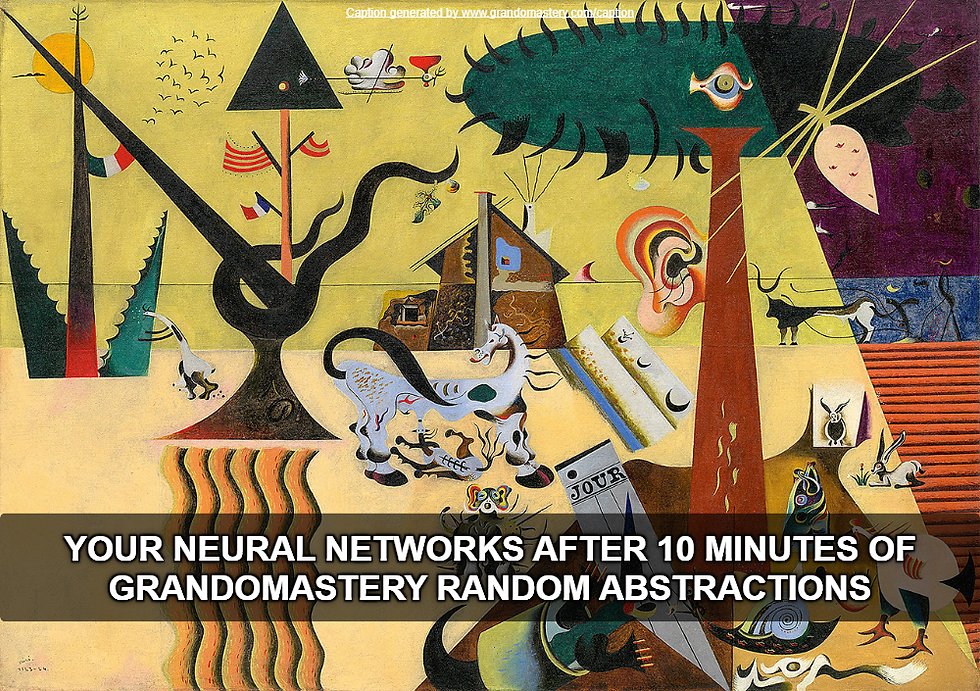
Activities like Random Abstractions embody this philosophy. The task isn't to demonstrate knowledge – it's to generate insight by finding meaningful relationships between randomly paired concepts. There are no correct answers, only more and less interesting ones. Success means surprising yourself with connections you didn't know you could make.
The theoretical foundation draws heavily from Arthur Koestler's concept of bisociation – the creative act of perceiving a situation through two habitually incompatible frames of reference simultaneously. Creativity emerges not from linear thinking within a single framework but from the collision of different conceptual planes. This requires cognitive playfulness because you must hold both frameworks in mind without immediately resolving the tension between them.
Neuroscientists studying insight and creativity consistently find that breakthroughs involve temporary increased connectivity between brain regions that don't normally communicate. The moment of insight – the "aha!" experience – corresponds to a burst of gamma-band activity in the right anterior temporal lobe. But this only happens when the brain is in a state that permits unexpected associations, when the usual constraints on thought have been loosened.
Cognitive playfulness creates those conditions. It's not frivolous or childish; it's how the adult brain maintains its capacity for innovation. When we stop playing with ideas, we don't just lose creativity – we lose adaptability, resilience, the ability to handle novelty without anxiety.
I see the costs daily. Talented professionals who can execute complex procedures flawlessly but cannot adapt when those procedures fail. Language learners who can parse difficult texts but cannot generate original thoughts worth expressing. Students who ace standardized tests but struggle with anything genuinely open-ended.
The problem accelerates as AI takes on more cognitive labor. If we delegate creative synthesis to machines because it's faster or easier, we stop exercising the neural networks responsible for that synthesis. The capacity atrophies from disuse. We become dependent on external tools for functions our brains evolved to perform.
This creates a paradox: as AI becomes more capable of mimicking human creativity, actual human creativity – the kind that emerges from genuine cognitive play rather than pattern matching – becomes more valuable precisely because it cannot be automated. But only if we maintain it.
The path forward requires deliberate practice. We need to create spaces where cognitive playfulness is not just permitted but required. Where the goal isn't to reach predetermined conclusions but to explore conceptual territory and see what you find. Where mistakes and false starts are understood as necessary parts of the process rather than failures.
This isn't about rejecting structure or rigor. Cognitive playfulness works best within constraints – the Oulipo movement in literature demonstrated this beautifully by using strict formal constraints to generate unexpected creativity. The key is that the constraints should prompt exploration rather than limit it to predetermined paths.
For language learners specifically, this means moving beyond communicative competence toward what might be called "creative competence" – the ability to use language not just to convey predetermined meanings but to discover meanings through the act of expression itself. To write or speak not because you know what you want to say but to find out what you think.
The neuroscience of language acquisition supports this. Adult language learning isn't just about memorizing words and rules; it's about building new conceptual structures and establishing connections between them. This requires the same kind of exploratory, generative thinking that drives creativity in any domain. When we reduce language learning to mechanical skill acquisition, we make it both less effective and less sustainable.
I designed activities like Random Because to address this directly. The task forces learners to construct causal relationships between randomly generated causes and effects, situations that don't obviously connect. There's no way to succeed through memorization or formula application. You have to improvise, to generate connections that weren't there before you thought of them.
This is what cognitive playfulness looks like in practice: the willingness to engage with conceptual challenges that don't have clear solutions, to treat thinking as exploration rather than problem-solving, to value interesting failures over safe successes. It's a capacity we all possess naturally as children but must consciously maintain as adults if we want to keep developing rather than calcifying.
The implications extend far beyond language learning. Every domain benefits from practitioners who can play with its core concepts rather than just apply them mechanically. Science advances through thought experiments and speculative models. Art evolves through experimentation and rule-breaking. Business innovation comes from seeing possibilities others miss.
But none of this happens without cognitive playfulness – the fundamental capacity to hold ideas lightly, to recombine them promiscuously, to follow tangents without knowing where they lead. It's the opposite of instrumental thinking, which always asks "what is this for?" Cognitive play asks instead "what is this like?" and "what if?" and "why not?"
These questions don't feel urgent in a world optimized for efficiency. They seem like luxuries, things to indulge when serious work is done. But they're actually prerequisites for the serious work being genuinely creative rather than merely competent. Without cognitive playfulness, we can only execute variations on existing patterns. We cannot generate genuinely novel responses to novel situations.
This is what I'm trying to preserve and develop through Grandomastery – not just language skills or creativity in the abstract, but the specific cognitive capacity that makes human thinking irreducibly human: our ability to play with reality, to imagine alternatives, to find meaning in unexpected places. It's what separates insight from information processing, understanding from mere pattern recognition.
The stakes are higher than they appear. As AI systems grow more sophisticated, the gap between genuine creativity and impressive simulation will become harder to detect from the outside. But the internal experience is categorically different. One emerges from exploration and discovery; the other from optimization and retrieval. One requires cognitive playfulness; the other can proceed in its absence.
We're at risk of producing generations of highly educated people who can operate effectively within established frameworks but cannot generate new ones. Who can follow complex procedures but cannot improvise when those procedures fail. Who can communicate efficiently but cannot think creatively. This isn't a language problem or a creativity problem – it's a fundamental cognitive capacity we're letting atrophy because we've stopped valuing it.
The solution starts with recognition: cognitive playfulness matters. It's not supplementary to serious thinking; it's foundational. And like any capacity, it requires regular exercise. We need to build it into education, professional development, and personal practice. Not as entertainment or relaxation, but as essential maintenance of the kind of minds we want to have and the kind of world we want to create.
#grandomastery #cognitivescience #creativity #languagelearning #criticalthinking #educationinnovation #neuroscience #creativethinking #adulteducation #cognitivepsychology #languageteaching #innovativeeducation #higherorderthinking #ESL #TESOL #professionaldevelopment #creativepedagogy #learningscience #thoughtleadership #edtech #21stcenturyskills #TEFL #languageacquisition #cognitivedevelopment #innovativelearning #brainscience #humancreativity #adaptivethinking #futureoflearning #abstractreasoning

Comments