The Story You Can't Yet Tell: Why Narratological Thinking Is the Most Neglected Skill in Advanced Language Education
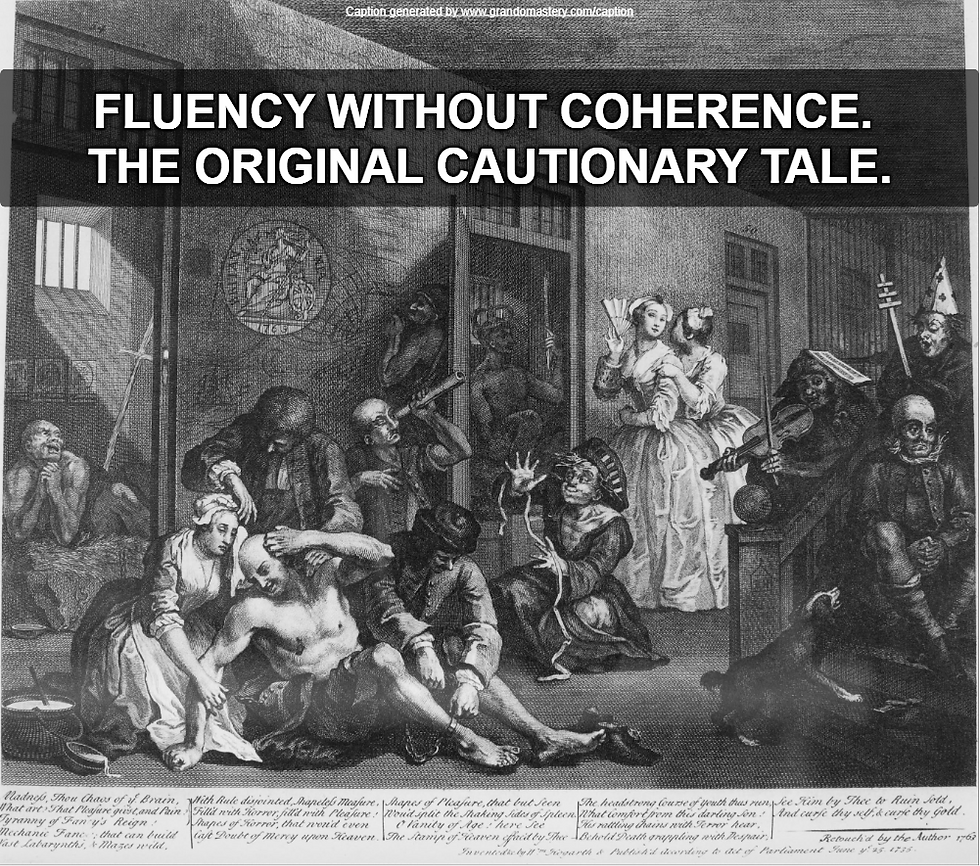
There is a peculiar blind spot in how we train language and communication. Grammar gets measured. Vocabulary gets tested. Pronunciation gets corrected. But the capacity to construct a coherent, engaging, emotionally resonant narrative in real time - the one skill that humans deploy in virtually every meaningful exchange - is largely left to chance. We assume people either have it or they don't, as if it were a personality trait rather than a cognitive faculty that can be developed with the right friction.
This assumption costs us more than we tend to notice.
Narratology - the systematic study of narrative as a cognitive and cultural structure - is not the same as "storytelling tips." The distinction matters. Jerome Bruner, whose work on narrative identity fundamentally reshaped cognitive science, argued that human beings operate in two irreducibly different modes of thought: the logico-scientific mode (paradigmatic), which deals in argument, proof, and abstraction, and the narrative mode, which deals in intention, circumstance, and human time. Most educational systems train the first almost exclusively. The second is treated as decoration, as soft, as something that happens in creative writing electives rather than as a core cognitive instrument.
Yet Bruner's research showed that it is narrative - not argument - through which people construct identity, make ethical decisions, interpret ambiguous situations, and sustain memory. The psychologist Dan McAdams extended this into what he called narrative identity theory: the self, he proposed, is not a fixed entity but an ongoing autobiographical story that a person is constantly revising. A person who cannot construct that story coherently, especially in a second language, is working with a fractured sense of self in that language - and this shows up not in grammar errors but in something harder to name: a flatness, an inauthenticity, a communication that is technically correct but somehow not fully inhabited.
Impaired narrative identity construction in L2 is a real and documented phenomenon. When someone can only access their inner story through their native language, large portions of their thinking, their humor, their irony, their emotional texture remain stranded there. The second language becomes a procedural layer rather than a place where thought genuinely lives.
This is one reason why advanced language learners - C1, C2, even near-native speakers - often plateau in ways that vocabulary lists or grammar exercises cannot address. The plateau is not lexical. It is narratological. They can describe. They cannot yet propel. They can report. They cannot yet inhabit.
The tools that narratology actually offers are not well known outside literary theory, which is itself part of the problem. Greimas' actantial model, for instance, maps the deep grammar of any narrative - not in terms of character description but in terms of structural roles: subject, object, sender, receiver, helper, opponent. Understanding that every story is fundamentally about a desire, an obstacle, and a transformation gives a speaker or writer a generative scaffold rather than a mimetic one. They are not copying story shapes they have seen; they are building from structural principles.
Gérard Genette's work on narrative time is equally practical and equally ignored in language education. Narrative time is not clock time. A story can expand a single moment across three pages and compress three years into a sentence. It can move backward, loop, flash forward. The manipulation of narrative time is how skilled speakers create tension, implication, irony, and surprise in speech - not just in literature. When someone delivers a compelling anecdote at a dinner table or makes a devastating point in a negotiation, they are almost always doing something with time: withholding, accelerating, returning. This is a learnable technique, not a talent.
Walter Fisher's narrative paradigm - the argument that all meaningful human communication is fundamentally narrative in structure, including political rhetoric, legal reasoning, and scientific discourse - has significant implications for education. Fisher proposed that narrative rationality operates through two criteria: coherence (does the story hang together internally?) and fidelity (does the story resonate with what the listener knows to be true about human life?). These criteria are not aesthetic niceties. They are the conditions under which communication actually persuades, connects, and endures.
What is underappreciated in language training is how much of this can be made visceral and generative through structured improvisation. The problem with explicit instruction in narrative technique is that knowing the principle is not the same as being able to deploy it under pressure, in real time, in a second language, with all the cognitive load that entails. The gap between knowing and doing is not bridged by more knowing. It is bridged by repeated, low-stakes practice in conditions that approximate real communicative pressure without the social cost of actual failure.
This is where tools that force narrative construction from unexpected or dissonant prompts have a genuinely functional role - not as games but as cognitive training. Narrative Transportation Theory (Green and Brock, 2000) demonstrated that when a person becomes genuinely absorbed in constructing or receiving a narrative, their capacity for critical resistance drops and their capacity for meaning integration rises. The brain processes a well-constructed narrative differently from a list of facts. Crucially, the same absorption effect applies to the narrator, not just the audience. The act of building a story in real time recruits integrative cognitive processes - default mode network activation, temporal reasoning, theory of mind, emotional simulation - that purely analytical or transactional communication does not.
Grandomastery (https://grandomastery.com) has built a substantial number of activities around exactly these principles without, characteristically, advertising that fact very loudly. Activities like Random Story (https://grandomastery.com/story), Random Emojis (https://grandomastery.com/emojis), Random Audiostory (https://grandomastery.com/audiostory), and Random Mystery Box (https://grandomastery.com/mysterybox) are not storytelling exercises in the casual sense. They are structured encounters with narrative dissonance - situations where the expected connections between elements are unavailable, and the speaker must generate coherence from the inside rather than retrieve it from memory or convention. Random Dharma (https://grandomastery.com/dharma) pushes further, requiring the construction of narratives that carry philosophical and moral weight across literal, metaphorical, and absurdist registers simultaneously.
The theoretical grounding here is Hofstadter's strange loops - the principle that self-referential, hierarchically layered systems produce emergent meaning that cannot be predicted from their components. A story that emerges from the collision of unrelated randomly assigned elements is doing exactly this: the narrator becomes the loop, the strange attractor that gives coherence to disparate inputs. This is not an easy thing to do. It requires what Koestler called bisociation - the simultaneous operation of two distinct conceptual matrices - and it produces, when it works, the specific cognitive satisfaction of the "Aha" moment: the sudden recognition that two things belong together in a way that was not previously visible.
There is also the question of what Jerome Bruner called "narrative accrual" - the way that individual stories accumulate into the shared story of a community, institution, or culture. This has direct practical relevance. In professional and educational contexts, the person who can construct a compelling, coherent narrative in real time - who can make the unexpected meaningful, who can hold an audience through structural tension rather than through volume or authority - has a distinct communicative advantage that no amount of vocabulary acquisition can replicate. This is not about entertainment. It is about the ability to create shared meaning under conditions of uncertainty, which is most of the meaningful communicative work that adults actually do.
The neuroscience supports the urgency here. Paul Zak's research on oxytocin demonstrated that narrative tension - specifically the arc of a character in peril - triggers measurable neurochemical changes in the listener that increase attention, empathy, and pro-social behavior. The brain, it turns out, is not a passive receiver of stories. It enacts them. Uri Hasson's neural coupling research at Princeton showed that when a story is told well, the listener's brain begins to mirror the neural patterns of the narrator - a phenomenon he called "neural coupling." The more coherent and engaging the narrative, the higher the coupling. Communication, in other words, is a form of neurological synchronization, and narrative is its most powerful medium.
None of this happens automatically. And almost none of it is being trained deliberately in language classrooms, professional development programs, or creativity workshops - places where it would be most useful. The assumption remains that narrative competence is a byproduct of general language proficiency, that it will emerge on its own once the grammar is right and the vocabulary is wide. It will not. It is a separate and highly specific cognitive skill that requires its own practice regime, its own forms of productive failure, and its own feedback loops.
The word "narratological" should not live only in literary theory seminars. It names something that happens in job interviews, in team meetings, in classrooms, in therapy, in political speeches, in the three-minute explanation of why a project matters. Wherever human meaning is at stake, narrative structure is either working for you or against you - and in most educational and professional contexts, it is neither understood nor practiced with anything like the intentionality it deserves.
#grandomastery #narratology #storytelling #cognitivescience #languagelearning #ESL #ESOL #creativewriting #narrativeidentity #bisociation #advancedEnglish #EdTech #creativeresilience #highorderthinking #improvisation #languageeducation #TESOL #TEFL #creativethinking #cognitiveflexibility #languageteachers #Bloomstaxonomy #narrativethinking #ESLteacher #TESOLteachers #languagefluency #ELT #ESLresources #creativeeducation #21stcenturyskills #languagecreativety #metacognition #divergentthinking #ESLactivities #cognitivedevelopment #humancreativity #professionaldevelopment #CPD #grandomasteryblog

Comments